.
Déplier les (non-)frontières
.
Arprim (372, rue Sainte-Catherine O. # 426)
exposition du 11 septembre au 25 octobre 2025
vernissage jeudi 11 septembre, 17 h 30
.
.
Il y a quelques années, je me suis posée dans une minuscule cabane forestière dépourvue d’eau courante. L’intrication de ce que je suis avec le milieu s’est alors imposée telle une évidence, de même que mon appartenance à l’écosystème planétaire et au cosmos. Dès lors que je me reconnais dans la biodiversité, tout acte d’agression à son égard devient impossible : y porter attention m’a rapidement incitée à poser les gestes du prendre soin, en élaborant par exemple des médiums de création écologiques et en me respectant davantage en tant que manifestation du vivant.
Le projet doctoral entamé à l’automne 2024 s’inscrit en continuité avec ce processus de réalisation de l’être dans la matière. Il vise à intégrer un -nouvel- écosystème forestier dans le respect du vivant et y produire des œuvres faites de matériaux biosourcés, afin d’étudier par la phénoménologie et la connexion à soi le processus de création inhérent à la vie et à l’art, puis partager l’expérience via ateliers et expositions.
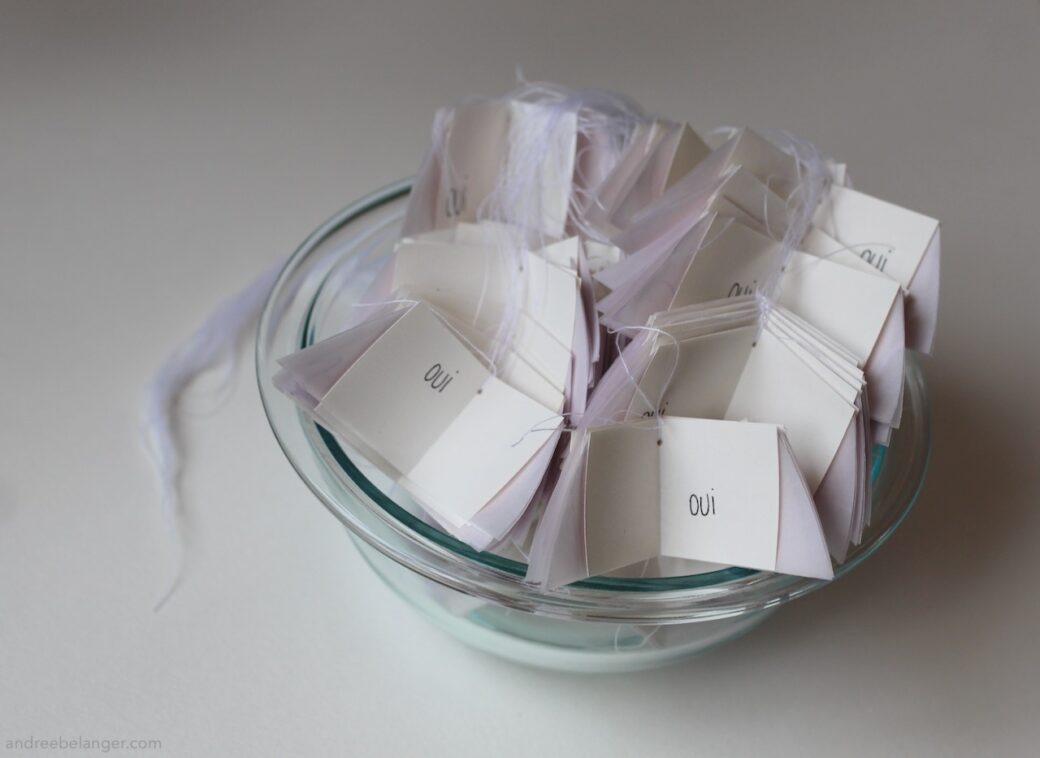
Déplier les (non-)frontières présente les traces issues des trois étapes initiales de ce travail de recherche-création : un premier semestre scolaire à Montréal, marqué par le choc avec les milieux urbain et académique (automne 2024) ; une retraite solitaire en forêt vouée à l’observation de l’expérience directe du phénomène de création (hiver 2025) ; un atelier d’intégration des aspects théorique et pratique du projet (printemps 2025).
À l’aube du parcours académique la question de l’expression se pose en obstacle, jusqu’à ce que j’expérimente l’intrication des langages artistique et académique à partir de la réalisation d’une œuvre : le processus de création renseigne en priorité les concepts, qui s’explicitent ensuite avec l’apport des références. Pour conserver mon intégrité il s’agit non d’utiliser la pensée mais de la vivre, de l’être dans toutes les dimensions de la réalité. À cet effet, j’embrasse la matérialité de la vie ordinaire, où se déploient directement et concrètement maintes manifestations des concepts de (non-)dualité et de (non-)frontière au cœur de ma philosophie. Ancrée au quotidien dans la connexion à soi, mes rythmes naturels se réhabilitent et engendrent les gestes du prendre soin. L’esthétique des œuvres reflète cette métamorphose, le soin apporté au processus de matérialisation témoignant de l’importance du message et la sobriété de la forme suggérant le caractère accessible du merveilleux immanent. Néanmoins, seule chez moi en forêt je vis le jeu de la multiplicité au cœur de l’unité sans discerner le point d’arrimage entre ces deux perspectives : l’être humain, en lequel je ne me reconnais que lorsque confrontée à un∙e autre. Dans la non-frontière absolue, aucun échange possible, tandis que la frontière constitue aussi bien un lieu de division que de rencontre ; toute relation suppose une distinction préalable, la présence d’au minimum deux entités. En endossant la vulnérabilité de l’individu je distingue la part humaine de l’écosystème, ce fameux canal humain par lequel s’intègrent et s’articulent les sphères théorique et physique.
L’art réalisé en connexion à soi nous rappelle l’essentiel. Non plus démuni∙es face à l’infinité de catastrophes dont le monde technologique n’a de cesse de nous tenir informé∙es, nous délaissons les réactions défensives inspirées de la peur pour nous tourner vers l’intériorité, et retrouver ainsi un état d’esprit favorable à l’action positive et collaborative. L’art permet d’investiguer et de partager l’indicible : lorsqu’il nous invite à nous reconnaître en le principe de (non-)frontière inhérent à la vie, il a le pouvoir d’inspirer des gestes guérisseurs et emplis de sens profond.
.
.
.Conférence d’artiste le jeudi 9 octobre, 14 h
Déplier les (non-)frontières : balbutiements pour une hybridation des langages
En partenariat avec le Centre de recherche Cultures – Arts – Sociétés (CELAT)
.
Présentation des travaux menés au cours de la première année de l’artiste au Doctorat en études et pratiques des arts (UQAM), durant laquelle elle s’interroge quant aux intersections fécondes entre l’art contemplatif sensible qu’elle pratique et les stratégies de transmission des concepts proposées par l’institution académique.
.
.
.
.
.
.
Ribambelle épiphanique d’une vie forestière ordinaire : Observation du processus de canalisation, matérialisation et transmission de la sensibilité au vivant et à l’immanent par la création artistique en connexion à soi (titre provisoire)
2024 –
.
Projet de recherche-création pour le Doctorat en études et pratiques des arts, UQÀM
.
.
Comment l’intégration en l’expérience directe des concepts de (non-)dualité et de (non-)frontière affecte-t-elle la création artistique ?
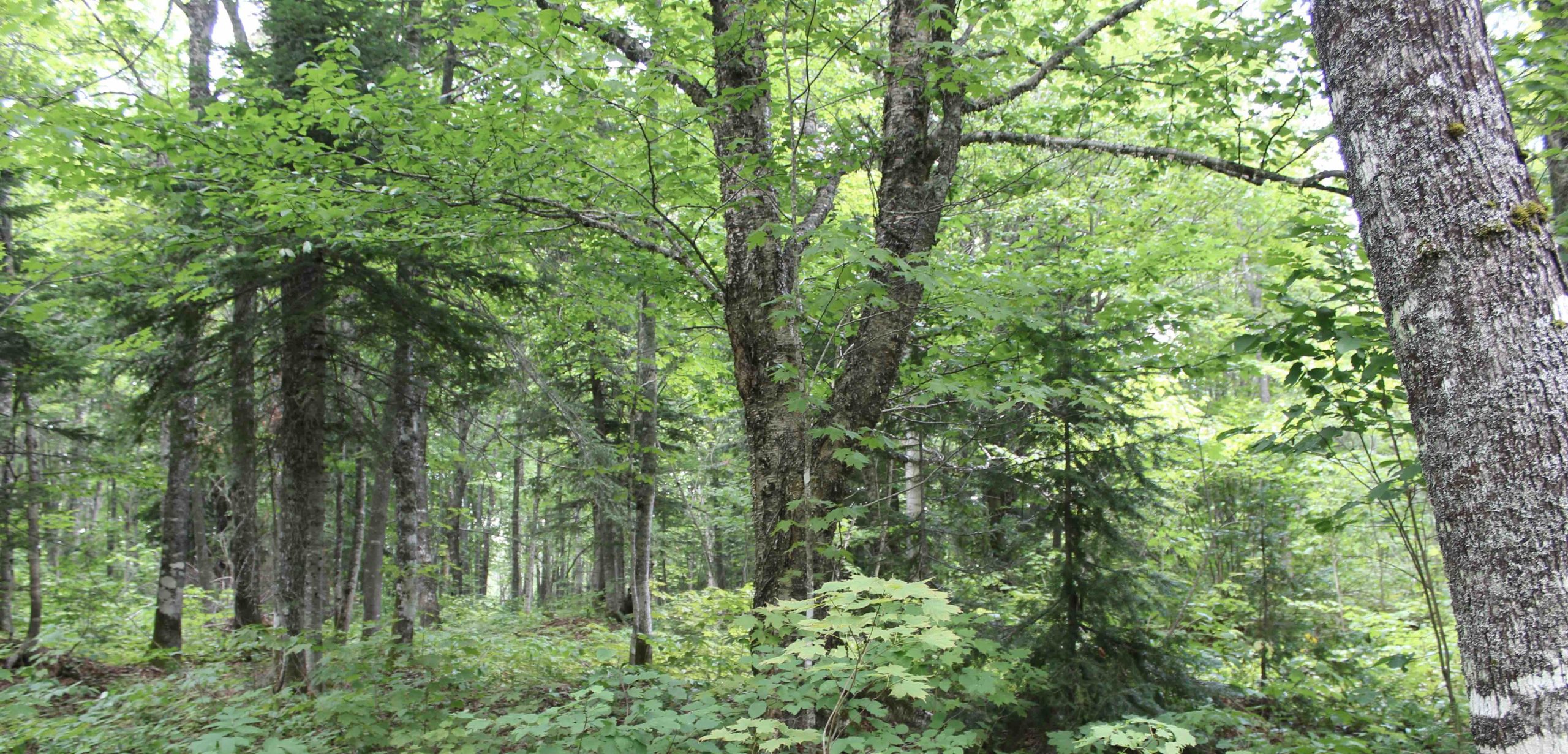
Le projet doctoral a pour objet d’étude le geste de création et de communication artistique qui s’accomplit dans une approche sensible tant au vivant qu’à l’immanent, c’est-à-dire en connexion à soi. J’explorerai au cours des prochaines années ce phénomène à travers l’intégration d’un écosystème forestier, la production d’oeuvres, l’observation du processus créatif et son explicitation.
.
.
.
.
.
.
.
Recherche pour la fabrication d’encre artisanale
2021-
.
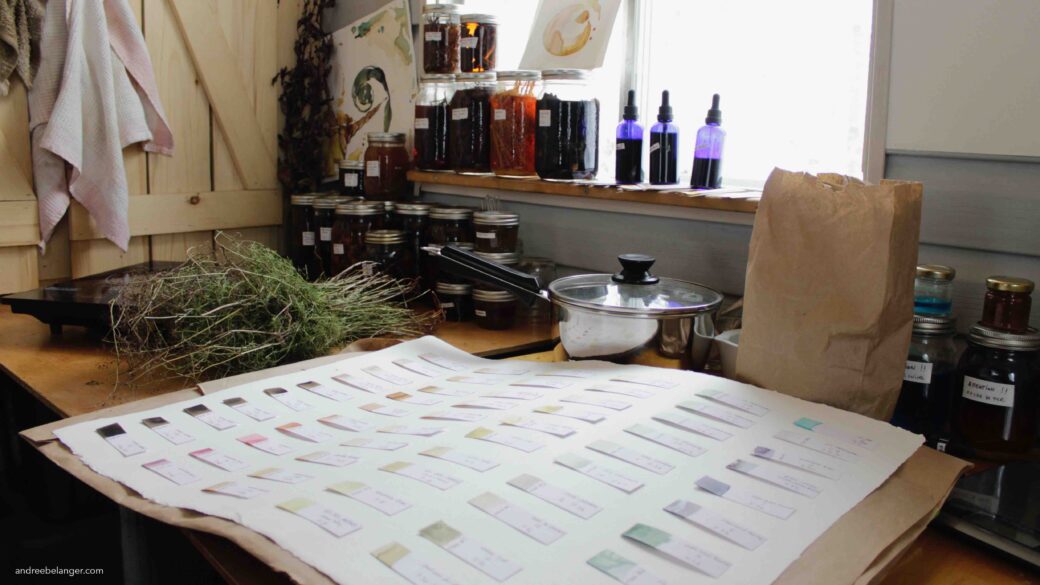
Apprendre à repérer, récolter et transformer les pigments minéraux et végétaux de ma région pour en faire de l’encre et créer ainsi une palette des couleurs de mon territoire. Présenter les résultats de cette recherche sous la forme d’ateliers et d’expositions.
.
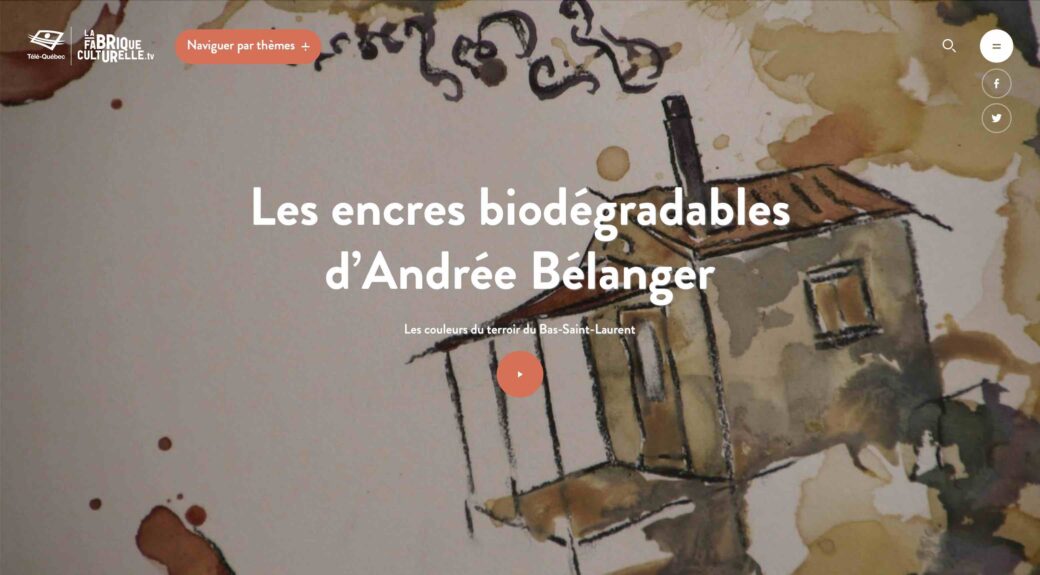
Court documentaire vidéo par William Bastille Denis (La Fabrique culturelle tv) sur le travail qu’accomplit l’artiste en connexion avec l’environnement forestier
.
Pour voir des oeuvres réalisées à l’encre artisanale : ici
.
Cette recherche a débuté via les projets Palette du terroir (2021), Nuances (2022) et Nuancier nature en fermentation (2023), lesquels ont été rendus possibles grâce à l’appui financier du Conseil des arts et des lettres du Québec (CALQ) dans le cadre du programme Exploration et recherche et du programme de Partenariat territorial avec le Bas-Saint-Laurent, ainsi que du Conseil des arts du Canada (CAC) dans le cadre du programme Explorer et créer – Recherche et création.
 …
…  …….
…….
L’artiste tient à souligner la collaboration de Cynthia Tellier Champagne (Studio d’art Shuffle), Claudine Cousineau et Martine Lecomte à titre de mentores pour la première partie de ce travail de recherche..
.
SURVOL RÉTROACTIF DES PROJETS ↓
Cliquer pour accéder à un bref survol des projets.
.
.
.
.
ARCHIVES
.
.
.
2024
.
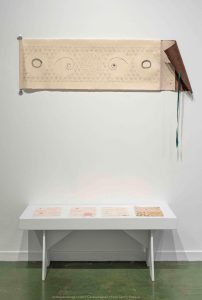
photo : Fanny Basque
Intimiste
.
exposition individuelle
.
livres d’artiste et traces du processus de création
Caravansérail (voir le site web)
15 au 18 août 2024
Rimouski (QC, Canada)
.
L’exposition dévoile le corpus d’oeuvres produit pour le projet expérimental Intimiste, lequel visait l’exploration picturale et littéraire par la création de carnets et de livres d’artiste dans un contexte de relation étroite avec la nature. Avec ce projet j’ai découvert le médium livre, une grande révélation. Par-dessus tout, c’est dans ce processus que les encres qui constituaient le coeur de ma recherche depuis trois ans ont enfin trouvé leur place au service des oeuvres.
.
Cette exposition a reçu le soutien de l’Entente de partenariat territorial entre le Conseil des arts et des lettres du Québec et la MRC de Témiscouata.
Je remercie du fond du coeur la reliéresse professionnelle Hélène Francoeur pour sa contribution au projet à titre de mentore.
.
.
.
2022
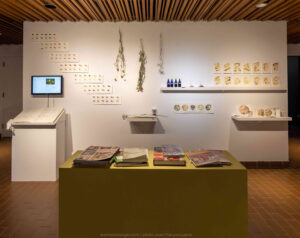
photo : Jean-François Lajoie
.
Écosystème(s)
.
exposition individuelle
.
installation rappelant l’atelier de l’artiste, œuvres à l’encre artisanale sur papier
Musée du Bas-Saint-Laurent (voir le site web)
7 octobre 2022 au 8 janvier 2023
Rivière-du-Loup (QC, Canada)
.
Fruit de mes premières recherches de création d’encres à partir de végétaux et minéraux, l’exposition révèle le processus qui entoure cette exploration ainsi que les premières œuvres qui en résultent. Elle présente ainsi toute la démarche et la réflexion qui m’ont amenée à concevoir ma création artistique dans un plus grand respect de l’environnement que j’habite. Par-dessus tout, il s’agit d’une invitation à réfléchir à notre place et notre rôle au sein des différents écosystèmes dans lesquels nous évoluons.
.
Pour voir des oeuvres réalisées à l’encre artisanale : ici
.
Cette exposition a reçu le soutien de l’Entente de partenariat territorial entre le Conseil des arts et des lettres du Québec et la MRC de Témiscouata.
.
.
.
2020
.
Nous territoires : l’essentiel n’est pas répertorié
.
.
Corpus d’oeuvres présenté lors des rencontres de la tournée itinérante, ici
Installation interactive réalisée pour le dernier événement, ici
.
.
.
.
.
.
.
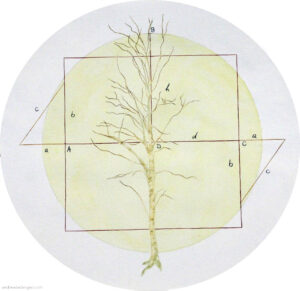
Ce projet a été rendu possible grâce à l’appui financier du Conseil des arts et des lettres du Québec (CALQ), dans le cadre de l’entente territoriale avec la région du Bas-Saint-Laurent. Andrée Bélanger tient à remercier les partenaires impliqué-es dans le projet aux diverses étapes de sa réalisation : Carrefour littéraire des arts et de la culture (CLAC) à Mont-Joli, Centre d’art de Kamouraska, Musée du Témiscouata, Municipalité de Sainte-Luce, Municipalité de La Trinité-des-Monts, Collectif Le Récif, Hélène Desjardins (mentore aquarelle), Michel Marcheterre (mentor géométrie), Yves Arcand (mentor photographie).
.
.
.
2019
.
Non-frontière et fragments en Témiscouata
.
exposition individuelle
.
installation vidéo, installation dessin, toiles à l’acrylique

Beaulieu culturel du Témiscouata

19 juillet au 11 septembre 2019

Témiscouata-sur-le-Lac (QC, Canada)
.
La réalité est faite de fragments apparemment épars qui prennent corps sous l’effet de nos sens. Ces fragments s’amalgament pour former un tout auquel nous donnons un sens, avant de le laisser se dissoudre à nouveau. Plus je définis les limites de ces fragments et du tout que j’en construis, plus elles m’échappent. La frontière existe et pourtant, elle est dénuée de substance : c’est une non-frontière, qui unit tout ce qu’elle divise. Le Témiscouata, brin d’univers, est lui-même constitué d’une infinité de fragments. Paradoxalement, c’est par sa singularité même qu’il se fond dans le monde, et qu’il le révèle. Ici, des morceaux du Témiscouata servent de prétexte et de support à l’exploration de réalités universelles.
.
.
.
2018
.
La non-frontière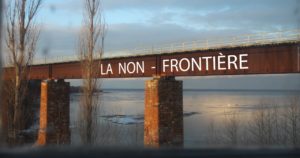
.
résidence de recherche-création
.
recherche individuelle et interactive (conversations, jeux écrits et visuels), rédaction d'un journal de résidence, production d'une série de toiles à l'acrylique sur matériaux trouvés sur place, lectures, planification (carte et graphique), soirée de clôture et de présentation (en duo avec Guillaume Aubertin, auteur-compositeur-interprète)

Collectif Le Récif

9 décembre 2017 au 27 janvier 2018

Rivière-Trois-Pistoles (QC, Canada)
.
J’ai fait au Récif l’expérience de la résidence d’artiste fondamentale : de l’espace et du temps.
Cette liberté m’a permis d’accomplir des découvertes qui outrepassent l’objectif que je m’étais fixé, soit planifier un projet artistique suivant le concept de « la non-frontière ». J’ai accepté de laisser couler le flot créatif de manière plus spontanée -voire ludique- sans tenter systématiquement de le canaliser vers les objectifs que je veux le voir servir. J’ai constaté les bienfaits de l’appel à collaboration aux étapes préliminaires de la création, et comprendre que le processus de réflexion collaborative constitue une oeuvre en soi. Enfin, au contact du Collectif, j’ai compris que ma démarche de création artistique était depuis le début de nature engagée.
.
Quelques exemples de questions posées aux membres et ami.es du collectif, par l’intermédiaire de grandes feuilles de papier affichées dans la cuisine de l’auberge tout au long de la résidence, et les conclusions principales qui ont été tirées de ces réflexions collectives :
.
La culture est-elle une institution?
La culture est la forme la plus fondamentale, puissante et insidieuse d’institution.
.
« L’Autre » existe-t-il?
On poursuit cet hypothétique « Autre » comme l’amour, ou on le fuit comme la mort.
.
La fin justifie-t-elle les moyens?
Les moyens trouvent leur juste mesure quand on les considère comme des fins en soi.
.
L’union fait-elle la force?
La force d’une union s’évalue à la force qu’elle apporte à chacun des individus qui la forment.
.
.
.
2017
.
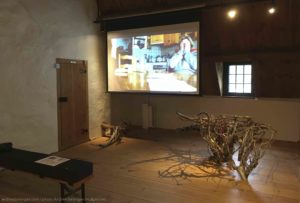
photo : Andrée Bélanger (sculpteure)
Origines et métamorphoses
.
résidence et exposition collectives
.
installation 3D pour le projet Terre de rencontres (duo avec Andrée Bélanger, sculpteure), court-métrage expérimental (individuel)

Société d’Art et d’Histoire de Beauport (SAHB), commissaire Anne-Yvonne Jouan

autres artistes participants : Andrée Bélanger (sculpteure), Adrien Bobin, Marie-José Gustave, Julien Lebargy, Nytha Oronga, Véronique Sunatori

mai à octobre 2017

Beauport (QC, Canada)
.
Cette résidence a amorti ma chute de retour au pays natal. Je ne m’y attendais pas. Je savais déjà que la communauté artistique constituait pour moi une famille professionnelle. Je viens de découvrir que je fais aussi désormais partie de la grande famille des émigrés. Je croyais que l’expérience de résidence me permettrait d’apprendre à travailler en collaboration, de développer mon réseau professionnel, de concrétiser un projet artistique. Ce fut le cas. Pourtant, je ne me doutais pas que je me trouverais chez-moi au coeur de cette micro-société d’artistes émigrés. Cette expérience marque la fin, et le début, du voyage. Je suis arrivée, et en même temps le monde m’est réellement ouvert pour la toute première fois.
.
.
.
Perspectives brutes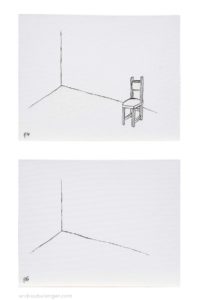
.
exposition individuelle
.
toiles à l’acrylique, performance interactive devant caméra

février-mars 2017

Allos, Thorame-Basse, Jouques (France)
.
L’exposition « Perspectives brutes » est le fruit d’une exploration débutée l’automne dernier au Mmiam (Musée minimaliste interuniversitaire des arts modestes) de Digne-les-Bains avec le projet « Perspectives sur la réalité ». L’artiste procédait alors d’un questionnement inspiré notamment des réponses proposées par la physique moderne sur la notion de réalité. Elle est maintenant passée à une observation plus directe des faits ; ni théorie ni rationalisation, que des perspectives brutes. L’artiste au style épuré repousse les limites du minimum pour montrer l’essentiel, à travers des images où l’objet et l’espace qui lui permet d’être sont tout autant sujet l’un que l’autre, où objet et espace se révèlent l’un l’autre.
.
.
.
2016
.
Perspectives sur la réalité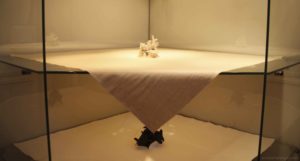
.
exposition individuelle
.
oeuvre installative sur deux sites

Musée minimaliste interuniversitaire des arts modestes (Mmiam)

18 octobre au 16 décembre 2016

Digne-les-Bains (France)
.
Toute chose est par nature indéfinissable. On peut décrire un phénomène de diverses manières dont aucune ne soit « fausse », mais la réalité dudit phénomène demeure insaisissable puisque mouvante par nature.
En physique quantique, la mesure d’une grandeur (par exemple la position d’un électron) a un effet radical : l’objet observé est généralement fortement perturbé. Avant mesure -et donc par nature- un électron est délocalisé ; après mesure de sa position, il est parfaitement localisé. Cette localisation est une des positions de l’électron délocalisé. Comme dès qu’on observe sa position l’électron devient localisé, on ne l’observe jamais dans son état -naturel- délocalisé ; on peut seulement inférer son état des nombreuses observations physiques qui ont été faites à ce jour.*
L’humain a besoin de « fixer » la réalité -par exemple à l’aide de la photographie- pour se donner le temps de l’observer, de l’étudier ; or, rien n’est réellement fixe. Ainsi, dans son processus d’investigation, l’humain dénature la réalité dont l’essence, inévitablement, lui échappe.
Qu’est-ce donc que la réalité? Insaisissable, elle ne peut s’appréhender qu’en intégrant son immuable mouvance. Elle se trouve -littéralement- « entre les lignes ».
.
*Notions de physique quantique tirées de BONNET, Gabrielle, « Fenêtre ouverte sur la physique quantique », Culture Sciences Physique : Ressources scientifiques pour l’enseignement de la physique, mise en ligne 21 octobre 2004 / consultée le 29 septembre 2016. http://culturesciencesphysique.ens-lyon.fr/ressource/Quantique.xml
.
.
.

photo : Anna Currenti
Point(s) de rupture
.
exposition individuelle
.
dessins à l'encre, toiles à l’acrylique, installations, sculpture sur marbre

août - septembre 2016

Digne-les-Bains et Peyrolles en Provence (France)
.
L’exposition « Point(s) de rupture » se veut une réflexion quant à ces petits et grands aléas de l’existence humaine qui nous la font paraître tantôt fascinante, tantôt absurde, et qui tissent une toile de données naturelles et culturelles qui se situe irrémédiablement au-delà de notre entendement.
Ces lieux où nos motifs se rompent finissent par former eux-mêmes une trame, une structure si vaste et si souple qu’on ne saurait la réduire à un schéma lisible. Pourtant naturelle et palpable, cette trame de l’existence humaine demeure pour nous un mystère, justement parce que nous en faisons si concrètement partie. Son modèle structurel nous englobe et nous dépasse. Points de rupture cycliques. Point de rupture.
.
.
.
La neige éparse : au centre de l’exil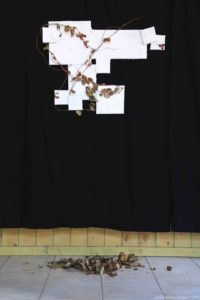
.
exposition individuelle
.
toiles à l’acrylique, dessins, installations, sculptures sur pierre

23 avril au 1er mai 2016

Allons (France)
.
L’artiste a quitté son pays depuis de longs mois. Après les tumultes de l’atterrissage, elle flotte et divague. Le territoire l’imprègne tant qu’elle s’y diffuse, dans un processus d’échange subtil et implacable. L’éphémère et l’essentiel fugitifs se laissent discerner, traçant de nouveaux sillons dans son propre territoire psychique.
.
.
.
2015
.
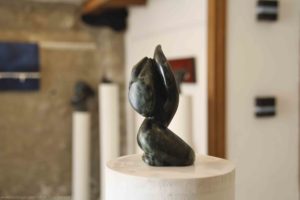
photo : Cléa Garnero
Dure plénitude
.
exposition en duo
.
toiles à l’acrylique, sculptures sur pierre

en collaboration avec Benjamin Garnero, sculpteur

18 août au 15 septembre 2015

Colmars les Alpes (France)
.
Dure plénitude témoigne de la difficulté -voire de la souffrance- inhérente à tout processus d’épanouissement et à toute démarche complètement intègre, de même que de la résistance et la force brute qui en sont à la fois la source et le fruit.
.
.
.
2014
.
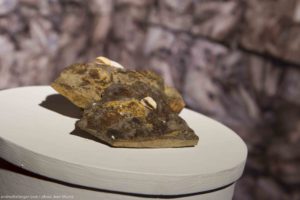
photo : Jean Munro
Trouver Diadem dans la fosse
.
exposition individuelle
.
installation photo murale, installation 3D sur socle, projection de court-métrage

En partenariat avec le centre de production vidéo et cinéma Paraloeil, et avec le Laboratoire d'archéologie et de patrimoine de l'Université du Québec à Rimouski (UQAR)

30 octobre au 30 novembre 2014

Rimouski (QC, Canada)
.
« On a tous déjà enterré quelque chose. »
.
Dans le but de bâtir une sculpture à partir d’ossements équins, j’entrepris d’exhumer ma jument enterrée dix-sept ans plus tôt sur la terre familiale. Informé du projet, l’archéologue Nicolas Beaudry me proposa d’emblée sa collaboration, et ce qui ne devait être qu’une formalité pour ramasser du matériel se transforma en un projet en soi. Cependant, la carcasse ayant été recouverte de chaux au moment de l’enfouir, les os n’étaient pas encore assez propres pour être ramassés. L’événement donna lieu à un court-métrage, et à une exposition présentant le court-métrage ainsi qu’une installation photo murale et une installation 3D sur socle. Cette dernière présente tout ce que j’ai pu extraire de la fosse : trois pierres et deux dents de cheval.
.
« J’aurais ben gardé l’cheval, j’aurais ben récupéré ses os, mais y a juste un squelette pourri. »
.
.
.
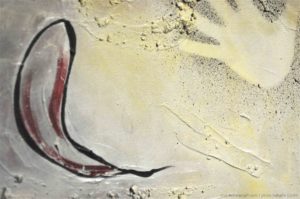
photo : Isabelle Godin
Origines
.
exposition individuelle
.
installation 2D (toiles à l’acrylique) et sculptures

Défi 35 – Fédération franco-ténoise

25 janvier 2014

Inuvik (TNO, Canada)
.
Je ne suis pas en mesure d’expliquer comment la civilisation a pu germer chez l’être humain paléolithique. Cependant, ayant adopté pour la production d’Origines une approche plus expérimentale permettant davantage de souplesse lors du processus de création, le résultat d’ensemble révèle un fragment de l’inconscient collectif. Celui-ci apparaît comme un élément essentiel pour comprendre la façon dont l’être humain conçoit puis adapte son environnement, au point d’en bâtir des civilisations.
.
.
.
2013
.
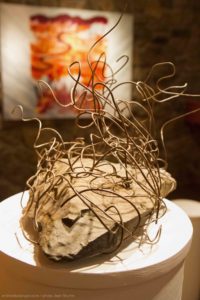
photo : Jean Munro
Civilisé
.
exposition individuelle
.
toiles à l’acrylique, installation 3D, performance

en collaboration avec le centre d’artistes Caravansérail

17 au 20 octobre 2013

Rimouski (QC, Canada)
.
L’être humain oppose facilement nature et civilisation, niant par le fait même ce dont il est fait. Bien sûr, il a depuis longtemps appris à adapter l’environnement à ses besoins plutôt que l’inverse. Or, l’accroissement démographique galopant a obligé l’humain en surnombre à se bâtir en société un système si complexe que ses individus doivent subséquemment s’adapter encore. Ce processus réussit par ailleurs au point que des circonstances artificielles soient regardées comme allant de soi. L’individu conforme peut alors s’en remettre aux institutions qui se nourrissent de lui, autorisant une très étroite relation d’interdépendance.
.
.
.
.
.
.
ME JOINDRE
EVENTS
.
Déplier les (non-)frontières
.
Arprim (372, Sainte-Catherine W. # 426)
Exhibition from September 11th to October 25th, 2025
Opening on Thursday September 11th, 5:30 pm
.
.
A few years ago, I settled into a tiny forest cabin with no running water. The entanglement of who I am with the environment then became self-evident, as did my belonging to the planetary ecosystem and the cosmos. From the moment I recognized myself within biodiversity, any act of aggression toward it became impossible: giving it attention quickly led me to take gestures of care, such as developing ecological creative mediums and respecting myself more deeply as a manifestation of life.
The doctoral project I began in the fall of 2024 continues this process of realizing being through matter. It aims to integrate into a -new- forest ecosystem with respect for all living things, and to create artworks using bio-based materials. Through phenomenology and connection to self, the project investigates the creative process inherent to both life and art, and then shares the experience through workshops and exhibitions.
Déplier les (non-)frontières presents traces from the first three stages of this research-creation work : a first academic semester in Montreal, marked by the shock of urban and academic environments (fall 2024); a solitary retreat in the forest, devoted to observing the direct experience of the creative phenomenon (winter 2025);
and a workshop integrating the theoretical and practical aspects of the project (spring 2025).
At the beginning of the academic journey, the question of expression presented itself as an obstacle—until I experienced the entanglement of artistic and academic languages through the creation of a work. In this process, creation primarily informs the concepts, which are then clarified with the support of references. To preserve my integrity, it is not a matter of using thought, but of living it—being it in all dimensions of reality. To this end, I embrace the materiality of ordinary life, where countless manifestations of the concepts of (non-)duality and (non-)boundary unfold directly and concretely—concepts at the heart of my philosophy. Grounded in everyday’s connection to self, my natural rhythms are restored and give rise to gestures of care. The aesthetics of the artworks reflect this metamorphosis: the attention given to the materialization process speaks to the importance of the message, while the sobriety of the form suggests the accessible nature of the immanent marvelous. Nevertheless, alone in the forest, I experience the play of multiplicity within unity without discerning the anchoring point between these two perspectives: the human being, whom I only recognize myself in when faced with another. In absolute non-boundary, no exchange is possible, whereas a boundary is both a site of division and of encounter; all relationship presupposes prior distinction—the presence of at least two entities. In embracing the vulnerability of the individual, I distinguish the human part of the ecosystem—this human channel through which theoretical and physical spheres are integrated and articulated.
Art created in connection to self reminds us of what is essential. No longer powerless in the face of the endless catastrophes the technological world keeps informing us about, we let go of fear-driven defensive reactions and turn inward, thus regaining a state of mind conducive to positive, collaborative action. Art makes it possible to investigate and share what cannot be spoken. When it invites us to recognize ourselves in the principle of (non-)boundary inherent to life, it holds the power to inspire healing gestures filled with deep meaning.
.
.
Artist talk Déplier les (non-)frontières : balbutiements pour une hybridation des langages (French)
Thursday October 9th, 2 PM
In partnership with Centre de recherche Cultures – Arts – Sociétés (CELAT)
.
Presentation of the work carried out during the artist’s first year of the Doctorate in Studies and Practices of the Arts (UQAM), during which she questions the fruitful intersections between the sensitive contemplative art that she practices and the strategies for transmitting concepts proposed by the academic institution.
.
.
.
.
.
.
Epiphanic parade within an ordinary forest life : Observation of the process of channeling, materialization and transmission of sensitivity to the living and the immanent through artistic creation in connection to self (temporary title)
2024 –
.
Research-creation project for the Doctorate in Arts Studies and Practices, UQAM (Montreal)
.
.
How does the integration of the concepts of (non-)duality and (non-)boundary into direct experience affect artistic creation ?
The purpose of the doctoral project is to study the act of artistic creation and communication which is accomplished through an approach sensitive to both the living and the immanent, that is, in connection to self. Over the next few years, I will explore this phenomenon through the integration of a forest ecosystem, the production of artworks, the observation of the creative process and its explanation.
.
.
.
.
.
.
.
Research for making handcrafted inks
2021-
.
Learn to locate, collect and process pigments from vegetals and minerals found in my area, in order to make a variety of inks and create a palette of my territory’s colours. Share the results of this research through workshops and exhibitions.
.
Short documentary video by William Bastille-Denis (La Fabrique culturelle tv) about the artist’s work from and within the forest (in French)
.
To see artworks made with handcrafted inks : here
.
This research was launched through the projects Bottling the Landscape, Subltleties and A Fermenting Colour Chart, which have been made possible thanks to the financial support of the Conseil des arts et des lettres du Québec (CALQ) as part of the Exploration and Research program and Territorial partnership (with Bas-Saint-Laurent) program, and of the Canadian Council for the Arts (CCA) as part of the Explore and Create – Research and Creation program.
……….
The artist wishes to acknowledge the collaboration of Cynthia Tellier Champagne (Studio d’art Shuffle), Claudine Cousineau and Martine Lecomte as mentors for the first part of the research work.
.
.
RETROSPECTIVE OVERVIEW OF THE PROJECTS ↓
Click to access a quick overview of the process.
.
.
.
.
.
.
ARCHIVES
.
.
.
2024
.
photo : Fanny Basque
Intimist
.
solo exhibition
.
artist’s books and traces of the creative process
Caravansérail (see website)
August 15th to 18th, 2024
Rimouski (QC, Canada)
.
The exhibition unveils the body of works produced for experimental project Intimist, which involved pictorial and literary exploration through the creation of artist’s books, in a situation of close relationship with nature. With this project I investigated a new medium, the book, which was a great discovery. Above all, it is in this process that the inks which constituted the heart of my research for three years finally found their place in the service of the artworks.
.
This exhibition is made possible thanks to the financial support of the Conseil des arts et des lettres du Québec (CALQ), as part of the Territorial Partnership with the area of Bas-Saint-Laurent.
I am wholeheartedly grateful to professional fine bookbinder Hélène Francoeur for her contribution as mentor to the project.
.
.
.
2022
photo : Jean-François Lajoie
.
Ecosystem(s)
.
.
solo exhibition
.
installation reminding of the artist studio, handmade inks on paper
Musée du Bas-Saint-Laurent (see website)
October 7th, 2022 to January 8th, 2023
Rivière-du-Loup (QC, Canada)
.
To see artworks made with handcrafted inks : here
.
This exhibition is the result of my first research to elaborate handcrafted inks from plants and minerals. It shows the process behind this exploration, as well as the first artworks I created with this medium. In its own way, it tells the story of how I came to conceive of my artistic practice through a greater respect of the environment I live in. Above all else, it is an invitation to contemplate on the part we take in the ecosystems within which we evolve.
.
This exhibition is made possible thanks to the financial support of the Conseil des arts et des lettres du Québec (CALQ), as part of the Territorial Partnership with the area of Bas-Saint-Laurent.
.
.
.
2020
.
Us, Our Territories : What Truly Matters is Unlisted
.
.
..
Main body of works shown on the touring exhibition, here
Interactive installation made for the last event, here
.
.
.
This project has been made possible thanks to the financial support of the Conseil des arts et des lettres du Québec (CALQ), as part of the Territorial Partnership with the area of Bas-Saint-Laurent. The artist wishes to acknowledge the collaboration of : Mont-Joli Arts and Litterature Centre (CLAC), Kamouraska Art Centre, Témiscouata Museum, Town of Sainte-Luce, Town of La Trinité-des-Monts, Le Récif Collective, Hélène Desjardins (watercolour mentor), Michel Marcheterre (geometry mentor), Yves Arcand (photography mentor)..
.
.
2019
.
Limitlessness and Fragments in Témiscouata
.
solo exhibition
.
video installation, drawing installation, acrylic paintings

Beaulieu culturel du Témiscouata

July 19th to September 11th, 2019

Témiscouata-sur-le-Lac (QC, Canada)
.
Reality is made of seemingly scattered fragments which take shape through the action of our senses. These fragments combine into a whole for which we make up a meaning, and then we let it dissolve again. The more I define the limits of these fragments and of the whole that I build out of them, the more these limits elude me. The frontier does exist, yet it has no substance : it is a non-frontier, which unifies all of that it divides. Témiscouata, speck of universe, is also composed of an infinity of fragments. Paradoxically, it is its singularity which makes it a part of the world, and which reveals the world. Here, pieces of Témiscouata are used as ways to explore universal realities.
.
.
.
2018
.
A Division is a Connexion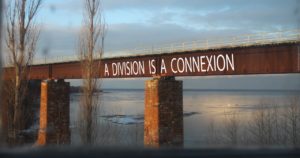
.
research-creation residency
.
solo and interactive research (conversations, written and visual games), writing of a residency diary, making of a series of acrylic paintings with supplies gathered in situ, readings, planning (map and graph), showing and closing evening (duo with Guillaume Aubertin, composer-interpreter)

Le Récif Collective

December 9th, 2017 to January 27th, 2018

Rivière-Trois-Pistoles (QC, Canada)
.
Within the Récif I experienced the fundamental artist residency : space and time.
This freedom led me to discoveries reaching beyond the objective I had set myself, which was to plan out an artistic project around the concept of « A Division is a Connexion« . I came to let inspiration flow more spontaneously, or even playfully, without trying to direct it towards the aims I would want it to serve. I witnessed the benefits of calling for collaboration at the early stages of creation, and I understood that this process of collective reflection is an arwork per se. Last but not least, living and working among the collective I came to realize that, from the very beginning, my approach to art making has been of a committed nature.
.
Here are a few exemples of the questions asked to the members and friends of the collective, through the mean of large sheets of paper put up in the hostel’s kitchen during the residency, and the main conclusions which came out of these collective considerations :
.
Is culture an institution?
Culture is the most fundamental, powerful and insidious type of institution.
.
Does « The Other » exist?
We run after this hypothetical « Other » as we run after love, or we run away from it as we run away from death.
.
Does the end justify the means?
A mean reaches the right balance when we regard it as an end in itself.
.
Does unity make strength?
The strength of an union is determined through the strength that it provides for the individuals who make it.
.
.
.
2017
.
photo : Andrée Bélanger (sculptor)
Origins and Metamorphoses
.
collective residency and exhibition
.
3D installation for Gathering Lands project (duo with Andrée Bélanger, sculptor), experimental short film (solo)

Beauport Art & History Society (SAHB), curator Anne-Yvonne Jouan

other participating artists : Andrée Bélanger (sculptor), Adrien Bobin, Marie-José Gustave, Julien Lebargy, Nytha Oronga, Véronique Sunatori

May to October, 2017

Beauport (QC, Canada)
.
This residency has cushioned my fall back into home country. I wasn’t expecting this. I already knew that the art community was some kind of a professional family to me. I just figured out that from now on I am also a part of the great family of the emigrants. I expected this residency to allow me to learn to work in partnership, to expand my professional network, to concretize an art project. It was the case. However, I never suspected that I would find myself at home among this micro-society of emigrant artists. This experience marks the end, and the beginning, of the journey. I have arrived, yet the world is truly open to me for the very first time.
.
.
.
Raw Perspectives
.
solo exhibition
.
acrylic paintings, filmed interactive performance

February-March, 2017

Allos, Thorame-Basse, Jouques (France)
.
The exhibition “Raw Perspectives” took shape during an exploration initiated last fall with the project “Perspectives on Reality”, which was carried out for the Mmiam (Intercollegiate Minimalist Museum of Modest Arts) in Digne-les-Bains, France. The artist was then inspired by the views of modern physics on the notion of reality. She has now moved on to a more direct examination of the facts : no theories or interpretations, only raw perspectives. The straightness of her style is now advanced to a minimum, in order to show the core of things, through images where the subject contains both the object and the space which allows it to be, where object and space reveal one another.
.
.
.
2016
.
Perspectives on Reality
.
solo exhibition
.
installation work on two sites

Musée minimaliste interuniversitaire des arts modestes (Mmiam)

October 18th to December 16th, 2016

Digne-les-Bains (France)
.
Every single thing in this world is, by nature, impossible to define in human terms. We can certainly describe a particular phenomenon in a variety of ways ; yet even if none of these would be “wrong”, we would still miss on the very reality of this phenomenon because its essence is of motion, and therefore is elusive.
In quantum physics, measuring a size (for example the position of an electron) has a radical impact : the observed object is usually greatly disrupted. Before measure -so by nature- an electron is delocalized ; after measure of its position, it is perfectly localized. This determined position is only one of the delocalized electron’s locations. Since the electron becomes localized as soon as its position is observed, we can never observe it in its -natural- delocalized state ; we can only infer its state from the numerous physical observations which have been made so far.*
Humans have a need to bring reality to a “standstill” -for example through photography- to allow themselves time to observe it, to study it ; however, nothing is ever really still. Therefore, through their very investigation humans alter reality, which essence inevitably escapes them.
So what is reality? It is fundamentally elusive, and can only be grasped by integrating its unfaltering flux. Reality is -literally- to be found “between the lines”.
.
*Notions in quantum physics taken from BONNET, Gabrielle, “Fenêtre ouverte sur la physique quantique”, Culture Sciences Physique : Ressources scientifiques pour l’enseignement de la physique, published online October 21st, 2004 / viewed September 29th, 2016. http://culturesciencesphysique.ens-lyon.fr/ressource/Quantique.xml
.
.
.
photo : Anna Currenti
Rupture(s)
.
solo exhibition
.
ink drawings, acrylic paintings, installations, marble sculpture

August – September, 2016

Digne-les-Bains et Peyrolles en Provence (France)
.
The exhibition « Rupture(s) » is about the various hazards of human existence that sometimes make it seem fascinating and sometimes make it seem absurd. These hazards weave into a web of both natural and cultural data which inevitably stands beyond our understanding.
These places where our schemes break end up making their own pattern. A structure so broad and fluid that it could not fit into a readable design. Even though natural and tangible, this framework of human existence remains a mystery to us, as we find ourselves intertwined within it. Its code encloses and transcends us. Cyclical ruptures. No rupture.
.
.
.
Scattered Snow : Core Exile
.
solo exhibition
.
acrylic paintings, drawings, installations, stone sculptures

April 23rd to May 1st, 2016

Allons (France)
.
It’s been months since the artist has left her country. After quite a bumpy landing, she’s just floating around, mystified. Slowly but surely, the new territory pervades her, and vice versa. Shifting ephemerals and essentials take fuzzy shapes, setting new landmarks on her own inner territory.
.
.
.
2015
.
photo : Cléa Garnero
Hard Fullness
.
duo exhibition
.
acrylic paintings, steatite and serpentine sculptures

in partnership with Benjamin Garnero, sculptor

August 18th to September 15th, 2015

Colmars les Alpes (France)
.
Hard Fullness testifies to the difficulty, or even suffering, inherent in any process of development and any completely honest approach, as well as the resistance and the brute force which are experienced as both the source and the fruit of it.
.
.
.
2014
.
photo : Jean Munro
Finding Diadem in the Pit
.
solo exhibition
.
wall photo installation, 3D installation on plinth, short film screening

In partnership with Paraloeil video production centre and theatre, and with the Archaeology and Heritage Laboratory of University of Québec in Rimouski (UQAR)

October 30th to November 30th, 2014

Rimouski (QC, Canada)
.
“We’ve all buried something at some point.”
.
In order to collect equine bones I would use to build a sculpture, I decided to dig out the mare I owned as a teenager, which had been buried on the family land seventeen years before. Having been told about the project, the archaeologist Nicolas Beaudry offered to collaborate on the exhumation. Slowly but surely, the seemingly simple step of collecting material turned into a project of its own. However, since the carcass had been limewashed when put underground, the bones were not clean enough to be gathered yet. The collective exhumation performance gave birth to a short film, as well as to an exhibition. The show included a screening of the short film, along with a mural photo installation and a 3D installation on plinth. This last piece was made of all I could take from the pit : three pieces of stone and two horse teeth.
.
“I would have kept the horse, I would have recovered her bones, but there’s nothing but a rotten skeleton.”
.
.
.
photo : Isabelle Godin
Origins
.
solo exhibition
.
2D installation (acrylic paintings) and sculptures

Défi 35 – Fédération franco-ténoise

January 25th, 2014

Inuvik (NT, Canada)
.
I cannot explain how civilization rooted in prehistoric humankind. However, since I have let the process of creation be pre-eminent and tried not to pre-judge the outcome while working on “Origins”, the end product gives a sense of the collective unconscious. And this might be a key to better understand the way humans conceive of and build civilization.
.
.
.
2013
.
photo : Jean Munro
Civilized
.
solo exhibition
.
acrylic paintings, 3D installation, performance

in partnership with artist-run centre Caravansérail

October 17th to 20th, 2013

Rimouski (QC, Canada)
.
That of which humankind is made is denied when civilization and nature are construed as opposites. Humans have long adapted their environments, rather than adapt to them. Now because of rapid population growth, humans have been forced to come up with societal systems, which, as it turns out, do not adequately meet their needs. Paradoxically then, individuals must now learn to adapt to these artificial constructs. What is amazing is that individuals’ attempts to adapt are usually so seamless that completely artificial situations are accepted as “common sense.” Individuals are no longer in the driver’s seat; Frankenstein’s monster lives. Members of society wallow in reassurance provided by the uniformity of the institutions which feed on their work. The relationship is interdependent and its ties bind.
.
.
.
.
.
.
CONTACT